
Industry:HR Compliance Added By:Admin Posted On:Nov. 20, 2026
Key points
Minimum wage by state for 2027: 16 states raise their minimum wage on January 1, 2027, and Alaska follows on July 1. Washington’s $17.73 becomes the highest state rate, while 20 states stay at the federal $7.25. The table below lists every state and D.C. with the current rate, the 2027 rate, the effective date, the tipped cash wage and the official source, checked on November 20, 2026.
Each rate is the general adult rate for most employers, taken from the state labor agency, the statute or the governor’s announcement. “No change” means state law sets no increase for 2027. “Not yet announced” means the law schedules an adjustment but the agency has not published the figure. Updating base rates is one line on the year-end payroll checklist; this table covers that line in detail.
| State | Rate now (2026) | 2027 rate | Effective | 2027 tipped cash wage | Source |
|---|---|---|---|---|---|
| Federal (FLSA) | $7.25 | $7.25 | No change | $2.13 | DOL WHD |
| Alabama | No state law | $7.25 (federal) | No change | $2.13 | DOL WHD |
| Alaska | $14.00 (since Jul 1, 2026) | $15.00 | Jul 1, 2027 | No tip credit | AK DOLWD |
| Arizona | $15.15 | $15.65 | Jan 1, 2027 | $12.65 | AZ ICA |
| Arkansas | $11.00 | $11.00 | No change | $2.63 | AR DOL |
| California | $16.90 | $17.40 | Jan 1, 2027 | No tip credit | CA Governor |
| Colorado | $15.16 | $15.71 | Jan 1, 2027 | $12.69 | CDLE |
| Connecticut | $16.94 | $17.48 | Jan 1, 2027 | $6.38 ($8.23 bartenders) | CT Governor |
| Delaware | $15.00 | $15.00 | No change | $2.23 | Del. Code |
| District of Columbia | $18.40 (since Jul 1, 2026) | Not yet announced | Jul 1, 2027 | $10.30, then 56% of new rate | DC DOES |
| Florida | $15.00 (since Sep 30, 2026) | $15.00 | No change until Jan 1, 2028 | $11.98 | FloridaCommerce |
| Georgia | $5.15 state; $7.25 federal applies | $7.25 (federal) | No change | $2.13 | GA DOL |
| Hawaii | $16.00 | $16.00 | No change until Jan 1, 2028 | $14.75 | HRS 387-2 |
| Idaho | $7.25 | $7.25 | No change | $3.35 | DOL WHD |
| Illinois | $15.00 | $15.00 | No change | $9.00 | IDOL |
| Indiana | $7.25 | $7.25 | No change | $2.13 | IN DOL |
| Iowa | $7.25 | $7.25 | No change | $4.35 | Iowa Code |
| Kansas | $7.25 | $7.25 | No change | $2.13 | K.S.A. |
| Kentucky | $7.25 | $7.25 | No change | $2.13 | KRS |
| Louisiana | No state law | $7.25 (federal) | No change | $2.13 | DOL WHD |
| Maine | $15.10 | $15.70 | Jan 1, 2027 | $7.85 | ME DOL |
| Maryland | $15.00 | $15.00 | No change | $3.63 | MD Labor |
| Massachusetts | $15.00 | $15.00 | No change | $6.75 | Mass.gov |
| Michigan | $13.73 | $15.00 | Jan 1, 2027 | $6.30 | MI LEO |
| Minnesota | $11.41 | $11.87 | Jan 1, 2027 | No tip credit | MN DLI |
| Mississippi | No state law | $7.25 (federal) | No change | $2.13 | DOL WHD |
| Missouri | $15.00 | $15.00 | No change | $7.50 | HB 567 |
| Montana | $10.85 | $11.20 | Jan 1, 2027 | No tip credit | MT DLI |
| Nebraska | $15.00 | $15.26 | Jan 1, 2027 | $2.13 | NE DOL |
| Nevada | $12.00 | $12.00 | No change | No tip credit | NV Labor |
| New Hampshire | $7.25 | $7.25 | No change | $3.27 | DOL WHD |
| New Jersey | $15.92 | $16.48 | Jan 1, 2027 | $6.61 | NJ DOL |
| New Mexico | $12.00 | $12.00 | No change | $3.00 | NM DWS |
| New York | $17.00 NYC, Long Island, Westchester; $16.00 rest | $17.00 / $16.00 | No change on Jan 1, 2027 | $11.35 / $10.70 (food service) | NY Governor |
| North Carolina | $7.25 | $7.25 | No change | $2.13 | NC DOL |
| North Dakota | $7.25 | $7.25 | No change | $4.86 | ND Labor |
| Ohio | $11.00 | $11.40 | Jan 1, 2027 | $5.70 | Ohio Commerce |
| Oklahoma | $7.25 | $7.25 | No change | $2.13 | OK DOL |
| Oregon | $15.55 standard (since Jul 1, 2026) | Not yet announced | Jul 1, 2027 | No tip credit | OR BOLI |
| Pennsylvania | $7.25 | $7.25 | No change | $2.83 | PA DLI |
| Rhode Island | $16.00 | $17.00 | Jan 1, 2027 | $3.89 | RI DLT |
| South Carolina | No state law | $7.25 (federal) | No change | $2.13 | DOL WHD |
| South Dakota | $11.85 | $12.30 | Jan 1, 2027 | $6.15 | SD DLR |
| Tennessee | No state law | $7.25 (federal) | No change | $2.13 | DOL WHD |
| Texas | $7.25 | $7.25 | No change | $2.13 | TWC |
| Utah | $7.25 | $7.25 | No change | $2.13 | DOL WHD |
| Vermont | $14.42 | $14.91 | Jan 1, 2027 | $7.46 | VT DOL |
| Virginia | $12.77 | $13.75 | Jan 1, 2027 | $2.13 | VA DOLI |
| Washington | $17.13 | $17.73 | Jan 1, 2027 | No tip credit | WA L&I |
| West Virginia | $8.75 | $8.75 | No change | $2.62 | WV DOL |
| Wisconsin | $7.25 | $7.25 | No change | $2.33 | WI DWD |
| Wyoming | $5.15 state; $7.25 federal applies | $7.25 (federal) | No change | $2.13 | DOL WHD |
A few states have more than one rate. Ohio’s $11.40 applies to employers with annual gross receipts above $419,000; smaller employers and workers under 16 get $7.25. Montana businesses not covered by the FLSA with gross sales of $110,000 or less may pay $4.00. New Jersey’s seasonal and small employers (fewer than six employees) pay $16.25, and agricultural employers pay $15.00. Arkansas, Illinois and Nebraska laws cover employers with four or more employees, and West Virginia’s covers six or more at one location. Where a state rate does not apply, FLSA-covered employers still owe $7.25.
Seventeen states have confirmed 2027 increases: Arizona, California, Colorado, Connecticut, Maine, Michigan, Minnesota, Montana, Nebraska, New Jersey, Ohio, Rhode Island, South Dakota, Vermont, Virginia and Washington on January 1, and Alaska on July 1. D.C. and Oregon adjust on July 1, 2027, but their figures will not be published until spring 2027.
Most January 1 increases are automatic. Arizona, California, Colorado, Maine, Minnesota, Montana, New Jersey, Ohio, South Dakota, Vermont and Washington adjust their rates each year by a consumer price index (CPI) measure written into state law, and Connecticut uses the employment cost index. The agencies announced the 2027 figures between August and November 2026; Vermont’s came on November 9.
Michigan reaches $15.00 on January 1, 2027, up from $13.73, under the 2025 amendments to the Improved Workforce Opportunity Wage Act (2025 PA 1). Tipped employees must get at least 42% of the minimum wage, or $6.30 an hour, and the rate for minors under 18 is 85%, or $12.75. The tipped percentage keeps rising each January until it reaches 50% in 2031, and the state treasurer begins inflation adjustments for 2028 in October 2027.
Not on January 1. Under New York Labor Law § 652, rates are indexed from 2027 unless an “off-ramp” condition is met, and the governor’s office says one was. The rates stay at $17.00 for New York City, Long Island and Westchester and $16.00 for the rest of the state. Home care aides still rise on January 1, 2027, to $20.00 downstate and $19.00 elsewhere.
Governor Hochul has proposed changing the off-ramp. If the legislature approves, new rates of $17.60 downstate and $16.55 upstate would take effect March 1, 2027. Treat that as a proposal, not a rate to load into payroll.
Alaska rises to $15.00 on July 1, 2027. D.C. raises its rate each July 1 by CPI, and its tipped wage is 56% of the new rate; the current rates are $18.40 and $10.30. Oregon’s Bureau of Labor and Industries publishes the July 1 rates by April 30. Portland metro stays $1.25 above the standard rate, and nonurban counties stay $1.00 below it. Several cities, including Chicago, Los Angeles and San Francisco, also change on July 1.
California’s minimum wage rises from $16.90 to $17.40 an hour on January 1, 2027, for employers of every size. The governor announced the increase on July 31, 2026, as the annual inflation adjustment under Labor Code section 1182.12. California does not allow a tip credit, so servers get $17.40 before tips.
The fast food restaurant minimum wage remains $20.00 an hour, the rate in force since April 1, 2024. The Fast Food Council can raise it, but the DIR fast food FAQ lists no increase for 2026 or 2027. Covered health care workers follow a separate schedule set by facility type:
The full schedule is in the DIR health care worker minimum wage FAQ.
Many California cities set their own minimums. On January 1, 2027, Mountain View goes to $20.25, Sunnyvale to $20.05, Palo Alto to $19.25, San Jose to $19.00 and San Diego to $18.35. San Francisco, Los Angeles and Berkeley adjust on July 1 instead. The local rates table below lists more.
Under Labor Code section 515(a), an exempt executive, administrative or professional employee must earn at least twice the state minimum wage for full-time work. At $17.40, that is $72,384 a year ($17.40 × 2 × 2,080 hours), up from $70,304. Exempt health care workers covered by the health care minimum wage need the greater of 1.5 times that rate or twice the state minimum wage. Washington also ties its exempt salary floor to a multiple of the state minimum wage. The federal rules are covered in the FLSA exempt salary threshold guide.
Washington, at $17.73 from January 1, 2027. Connecticut ($17.48) and California ($17.40) are next, followed by Rhode Island and downstate New York at $17.00. D.C. is higher than any state at $18.40, and its rate rises again on July 1, 2027.
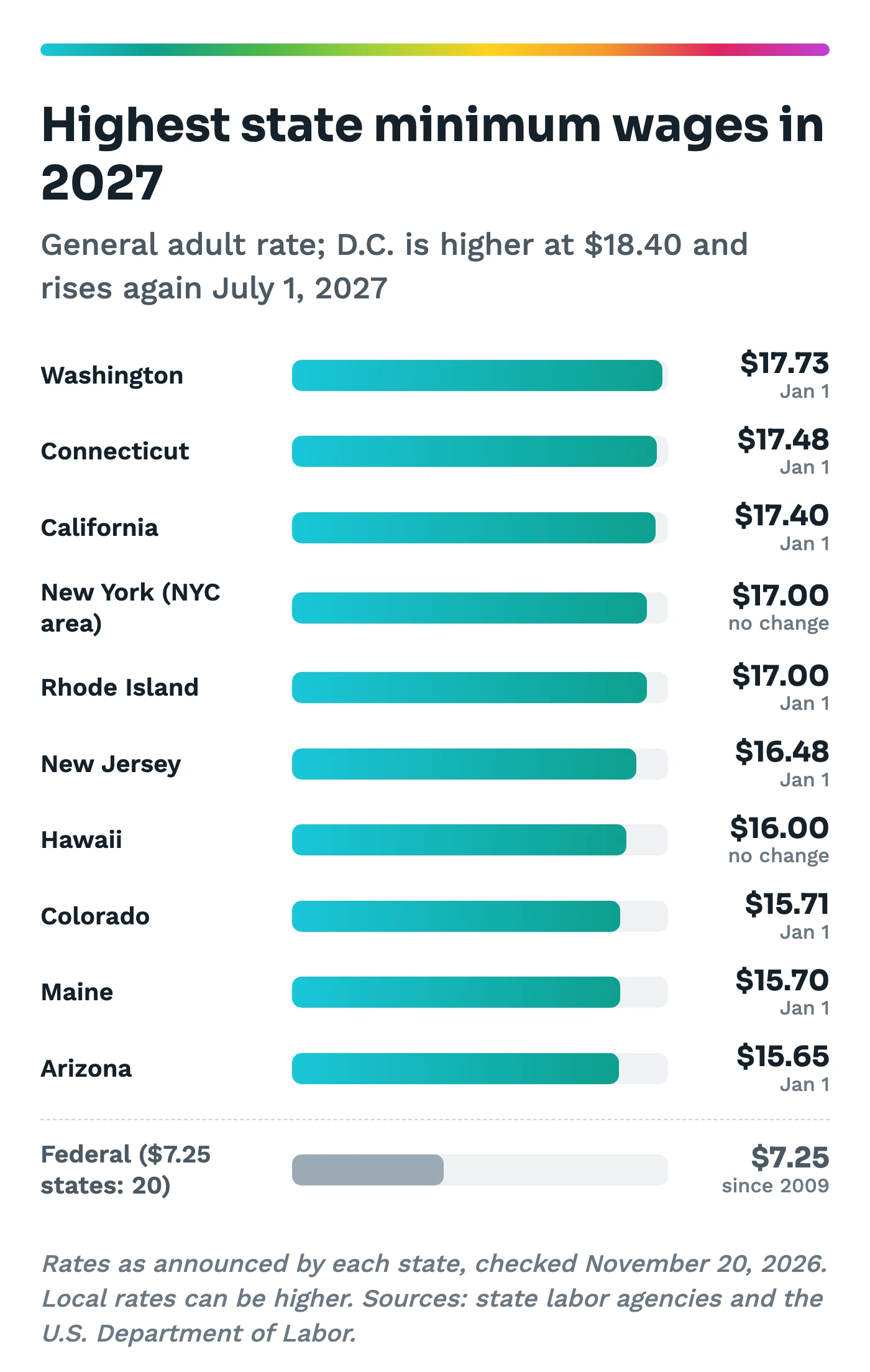
A city or county rate does not replace the state rate; it sits on top of it. Section 18 of the Fair Labor Standards Act (29 U.S.C. 218) keeps any higher state law or municipal ordinance in force, so the employer pays the highest rate that applies where the work is done. Rates below come from the city or county’s own announcement.
| City or county | Rate now | 2027 rate | Effective |
|---|---|---|---|
| Tukwila, WA | $21.65 | $22.45 | Jan 1, 2027 |
| Seattle, WA | $21.30 | $22.14 | Jan 1, 2027 |
| Mountain View, CA | $19.70 | $20.25 | Jan 1, 2027 |
| Sunnyvale, CA | $19.50 | $20.05 | Jan 1, 2027 |
| Denver, CO | $19.29 | $19.84 | Jan 1, 2027 |
| Palo Alto, CA | $18.70 | $19.25 | Jan 1, 2027 |
| San Jose, CA | $18.45 | $19.00 | Jan 1, 2027 |
| Flagstaff, AZ | $18.35 | $18.95 | Jan 1, 2027 |
| San Diego, CA | $17.75 | $18.35 | Jan 1, 2027 |
| Minneapolis, MN | $16.37 | $17.02 | Jan 1, 2027 |
| Saint Paul, MN (101+ employees) | $16.37 | $17.02 | Jan 1, 2027 |
| Howard County, MD | $16.00 | $16.45 | Jan 1, 2027 |
| Tucson, AZ | $15.45 | $16.00 | Jan 1, 2027 |
| San Francisco, CA | $19.61 | Not yet announced | Jul 1, 2027 |
| Los Angeles, CA | $18.42 | Not yet announced | Jul 1, 2027 |
| Montgomery County, MD (51+ employees) | $18.00 | Not yet announced | Jul 1, 2027 |
| Chicago, IL | $17.05 | Not yet announced | Jul 1, 2027 |
Saint Paul’s small employers (6 to 100 employees) stay at $16.37 until July 1, 2027, when they move to $17.02.
Twenty states effectively pay the federal $7.25 in 2027:
Among states with a rate above the federal minimum, West Virginia is lowest at $8.75. None of the 20 has a 2027 increase. Oklahoma voters rejected State Question 832, a $15 measure, on June 16, 2026. Pennsylvania’s House passed HB 2189 ($11 in 2027) in March 2026, but the Senate has not voted on it.
No. The federal minimum wage has been $7.25 an hour since July 24, 2009, and only Congress can change it. The Raise the Wage Act of 2025 (H.R. 2743 and S. 1332) and the Higher Wages for American Workers Act (S. 2013) have not moved past committee referral. The separate federal contractor minimum wage under Executive Order 14026 ended when Executive Order 14236 revoked it in March 2025, and DOL no longer enforces it.
Under the FLSA, an employer may pay a tipped employee a cash wage of $2.13 an hour and count up to $5.12 of tips toward the $7.25 minimum. If tips fall short in a workweek, the employer pays the difference. States can set a higher cash wage or ban the tip credit altogether, and the table above shows each state’s 2027 cash wage. DOL keeps a state tipped wage table as a cross-check.
Chicago is phasing out its tipped wage locally, with tipped workers at $12.96 since July 1, 2026. Check local ordinances before you apply a state tip credit.
Rates follow the employee’s work location, not the company’s headquarters. A remote employee who works from home in Denver is owed Denver’s $19.84, even if the employer is based in Texas.
For a full review of the FLSA rules behind these rates (hours worked, tip credits, the regular rate and exemptions), the live FLSA wage and hour compliance webinar is on December 2, 2026. Other wage and hour sessions are listed under HR compliance webinars.
It ranges from the federal $7.25, which applies in 20 states, to $17.73 in Washington. Sixteen states raise their rates on January 1, 2027, Alaska raises its rate to $15.00 on July 1, 2027, and D.C. and Oregon adjust on July 1 by amounts not yet announced. Local ordinances can require more.
Washington, at $17.73 an hour from January 1, 2027, followed by Connecticut at $17.48 and California at $17.40. D.C. is higher than any state at $18.40. Some cities go further, such as Tukwila ($22.45) and Seattle ($22.14).
Twenty: Idaho, Indiana, Iowa, Kansas, Kentucky, New Hampshire, North Carolina, North Dakota, Oklahoma, Pennsylvania, Texas, Utah and Wisconsin set $7.25. Georgia and Wyoming set $5.15, so the federal $7.25 applies to covered employers. Alabama, Louisiana, Mississippi, South Carolina and Tennessee have no state minimum wage law.
No. It has been $7.25 an hour since July 24, 2009, and the tipped cash wage remains $2.13. The Raise the Wage Act of 2025 and the Higher Wages for American Workers Act have been referred to committee, and neither has passed the House or the Senate.
It is $17.40 an hour from January 1, 2027, for all employers, up from $16.90. Fast food workers stay at $20.00, covered health care workers follow a separate schedule of $19.28 to $25.00, and many cities set higher local rates. The exempt salary minimum rises to $72,384.
The federal tipped cash wage is $2.13 an hour, with tips making up the rest of the $7.25. State rules vary widely: Alaska, California, Minnesota, Montana, Nevada, Oregon and Washington allow no tip credit, while Colorado requires $12.69 and Arizona $12.65 in cash wages in 2027.
Get payroll ready for January 1 rate changes
The live FLSA wage and hour webinar covers minimum wage, tip credits, the regular rate and exemptions that every new rate affects. Book one seat or the whole payroll team.
See the FLSA webinarThis article is general information, not legal or tax advice. Check the official sources above or consult a qualified advisor for your situation.