
Industry:FDA Compliance Added By:Admin Posted On:Nov. 24, 2026
Key points
A Form FDA 483 lists the conditions an FDA investigator found objectionable and is handed to management at the close of an inspection. A warning letter comes later, from FDA officials rather than the investigator, and says the agency considers the violations significant enough to lead to enforcement action if they are not corrected. An FDA 483 is not a final agency finding, and a written response within 15 business days lets FDA weigh your corrections before it decides on a warning letter, whether you make drugs, devices, biologics, food or other FDA-regulated products.
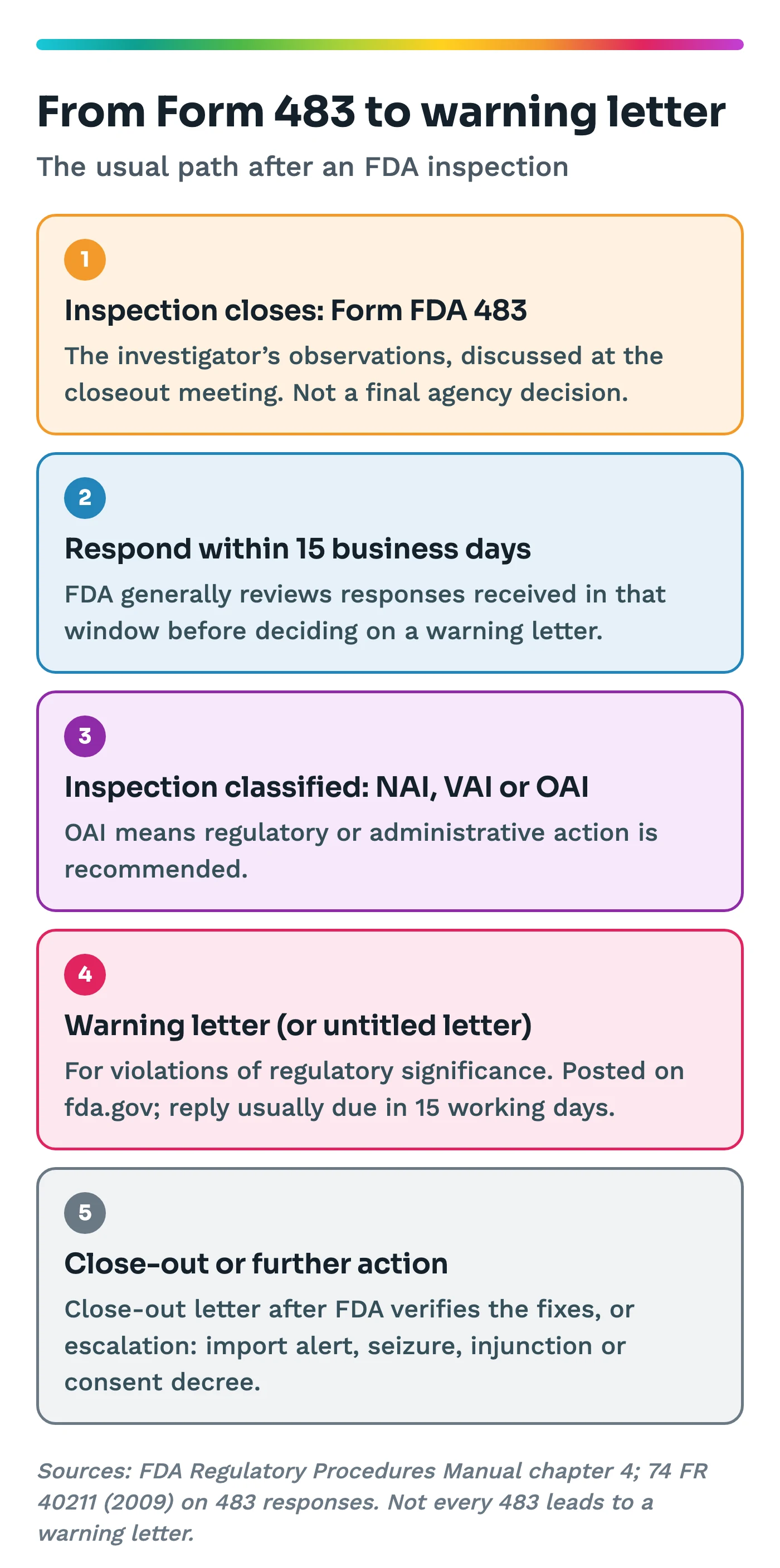
The two documents sit at different points of one process. The investigator issues the 483 on the last day of the inspection. FDA then reviews it with the investigator’s report and any response, classifies the inspection, and decides whether a warning letter, an untitled letter or no action is needed. Device inspections have followed Compliance Program 7382.850 since February 2, 2026, under the FDA QMSR, but observations still go on Form FDA 483, and FDA has said the threshold for compliance action has not changed.
| Feature | Form FDA 483 | Untitled letter | Warning letter |
|---|---|---|---|
| Who issues it | The investigator(s) who ran the inspection | An FDA compliance official, usually with center concurrence | A program office director, division director or higher official; many program areas need center concurrence |
| When | At the close of the inspection, in the closing discussion with management | After agency review, for violations below the warning letter threshold | After agency review of the 483, inspection report and any response; can also follow sample analysis or other evidence |
| Legal status | The investigator’s observations, not a final agency determination | Advisory; no warning that enforcement may follow | “Informal and advisory,” but it establishes prior notice before enforcement |
| Response | Voluntary; FDA reviews responses received within 15 business days before deciding on a warning letter | Requested, not required (for example, within 30 days) | Requested, usually within 15 working days of receipt |
| Made public? | Not automatically; selected 483s are posted or released under FOIA, redacted | Some are posted, such as letters about drug advertising | Yes, posted on fda.gov in redacted form |
| Typical next step | Response, inspection classification, release of the inspection report | Correction, checked at a later inspection | Response, follow-up inspection, then a close-out letter or escalation |
No. Under FDA’s Regulatory Procedures Manual (RPM), Chapter 4, warning letters are issued only for violations of regulatory significance: violations that may lead to enforcement action if not promptly and adequately corrected. FDA weighs the firm’s compliance history, the product risk, whether the firm knew of the problem, and whether its corrective action is adequate, documented and on a reasonable timeline.
Two cautions. Ongoing or promised corrections “generally do not preclude” a warning letter. And a warning letter is not a required step: FDA can go straight to enforcement when violations are repeated, intentional or flagrant, or present a reasonable possibility of injury or death. A warning letter can also arrive with no 483 at all, for example after a sample fails analysis.
Form FDA 483, “Inspectional Observations,” is issued to firm management at the conclusion of an inspection when the investigator has observed conditions that, in their judgment, may violate the Federal Food, Drug, and Cosmetic Act (FD&C Act) and related acts. Each observation is read and discussed with management before the investigator leaves. Some programs use their own versions, such as Form FDA 483a for Foreign Supplier Verification Program inspections and Form FDA 4056 for produce farms.
The 483 is not a full list of everything that may be wrong. FDA’s Form 483 frequently asked questions say it leaves out observations of questionable or unknown significance, and that companies are encouraged to respond in writing with a corrective action plan. For finished-drug manufacturers, 21 CFR 211.180(f) also requires procedures to notify responsible officials in writing of inspectional observations.
No. The form itself says the observations “do not represent a final agency determination regarding your compliance.” FDA weighs the 483 with the investigator’s Establishment Inspection Report (EIR), the evidence and your response. That is not a reason to ignore it: for drug CGMP inspections, FDA’s March 2026 draft guidance says a written response “may be the primary or a key component” of the agency’s review.
The EIR is the investigator’s narrative report. FDA then assigns a final classification, usually sent to the firm in a letter within 45 to 90 days after the inspection closes, according to FDA’s Inspection Classification Database page.
| Classification | What it means | Was a 483 issued? | What usually follows |
|---|---|---|---|
| NAI (No Action Indicated) | Acceptable state of compliance | Usually not | No further action |
| VAI (Voluntary Action Indicated) | Objectionable conditions found, but FDA will not recommend action and expects voluntary correction | Usually yes | Firm corrects; FDA checks at the next inspection |
| OAI (Official Action Indicated) | Unacceptable state of compliance; regulatory action is recommended | May have been | Warning letter, untitled letter, regulatory meeting or enforcement; an inspection that leads to a warning letter is classified OAI |
Under Field Management Directive 145, FDA sends the firm a redacted copy of the EIR narrative once the inspection is closed. If the inspection led to a warning letter, untitled letter or seizure, the EIR is not released until that matter is closed.
On May 6, 2025, FDA said it would expand unannounced inspections at foreign sites making food, medicines and other medical products, and that it can take regulatory action against firms that delay, deny or limit an inspection. From April 2026 through fiscal year 2026, FDA also piloted one-day, risk-selected inspectional assessments and said the pilot did not change enforcement policy.
An observation is a condition or practice the investigator considers significant and objectionable. FDA posts yearly counts of the regulations most cited on 483s (fiscal years 2006 to 2025), though they miss hand-written 483s. Themes differ by program:
Use the closing meeting. Ask the investigator to clarify any observation you do not understand, point out factual errors, and note corrections already made, which may be recorded on the 483. A response can also address verbal discussion items that were not written on the form. Staff preparation, conduct during the inspection and 483 responses are covered in the recorded FDA inspection and 483 webinar.
A warning letter is FDA’s principal means of getting prompt voluntary compliance and of establishing prior notice. The RPM calls it “informal and advisory”: it states the agency’s position but does not commit FDA to enforcement, and FDA does not treat it as final agency action that can be challenged in court. It is titled “WARNING LETTER,” addressed to the highest known official of the company, and cites the sections of law and regulations FDA says were violated.
Drug warning letters citing CGMP violations warn that FDA may withhold export certificates and approval of new applications or supplements that list the site. Device warning letters warn that Certificates to Foreign Governments may not be granted and that related Class III premarket approvals may be held until violations are corrected.
An untitled letter cites violations that do not meet the warning letter threshold. Under RPM section 4-2-1, it is not titled, contains no warning that enforcement may follow, does not trigger mandated follow-up, and requests rather than requires a written response within a reasonable time, such as 30 days. FDA uses untitled letters for drug advertising and promotion problems, among others, and posts those on its website.
A warning letter asks for a written response within a set time after receipt, usually 15 working days. FDA typically asks for each step taken or planned to correct the violations and prevent recurrence, the completion date, the reason for any delay, and documentation showing correction. If you believe a cited item is not a violation, send your reasoning and evidence. You can refer to your earlier 483 response and ask FDA to post your response next to the letter.
For warning letters issued on or after September 1, 2009, FDA can issue a close-out letter once violations are corrected. Promises are not enough: corrections must be made and verified, usually by a follow-up inspection that finds no other significant violations. FDA posts a close-out notice, but the warning letter stays on its website unless rescinded or amended. Violations that by their nature cannot be corrected get no close-out letter.
If the response is inadequate or never arrives, FDA follows up. The path is not a fixed ladder, and tools can run at once:
The RPM says FDA generally should not send a second warning letter for the same or similar violations, so a repeat finding is treated seriously. Even after a close-out letter, FDA may act without further notice if later inspections show the corrections did not hold.
Warning letters are posted in redacted form on FDA’s searchable warning letters page, along with any posted responses and close-out letters. Form 483s are not published automatically. Sources for them:
Expect more disclosure. In its Transparency Roadmap of October 2, 2026, FDA said it plans to proactively publish redacted 483s and additional EIRs where appropriate, with no schedule set as of November 2026. Write every response assuming customers and competitors may read it.
No regulation requires a response to a 483, but timing decides whether FDA reads it before deciding on a warning letter. Under a program announced in the Federal Register on August 11, 2009 (74 FR 40211), which began September 15, 2009, FDA generally allows 15 business days after the 483 is issued. A response in that window gets a detailed review, and any warning letter will comment on the apparent adequacy of your corrective actions. For a later response, FDA “will not ordinarily delay” a warning letter and will evaluate it with your warning letter response instead. FDA can still issue a warning letter at any time.
FDA’s draft guidance on responding to Form 483 observations (March 2026, docket FDA-2025-D-1504) repeats the 15-business-day recommendation for human and animal drug and biologics CGMP inspections. It is still a draft, not for implementation, as of November 2026, but it shows what reviewers look for:
Count on a calendar. A 483 issued Friday, December 11, 2026 needs a response by Tuesday, January 5, 2027, because December 25 and January 1 are federal holidays. If federal offices also close on an extra day, such as December 24, aim for the earlier date.
Device firms have one more option. Under section 704(h)(2) of the FD&C Act, added by FDARA in 2017, they can request nonbinding feedback on proposed actions for observations involving a public health priority, systemic or major actions, or emerging safety issues. FDA’s April 2020 guidance treats a request as timely within 15 business days after the 483, and FDA then has 45 days to reply.
When fixes take longer than 15 business days, the draft guidance recommends sending preliminary results, a completion timeline and interim controls, then follow-up reports on a schedule you set in the first response. Keep every date: FDA verifies the work at the next inspection.
A strong response shows that management understands each observation, found the cause and fixed the system, not only the example the investigator saw. Steps after the closing meeting:
The draft guidance suggests a summary table FDA can scan on one page. A format based on it:
| Observation | System or category | Summary of issue and CAPA | CAPA number | Target date | Status |
|---|---|---|---|---|---|
| 1. Cleaning validation (example) | Facilities and equipment | Cleaning procedure not validated for shared equipment; investigation extended to all lines | CAPA-0000 | Date, with interim controls noted | To be started, in progress or complete |
For a walk-through of response structure, the recorded Writing Effective 483 and Warning Letter Responses webinar covers the response timeline, the elements and structure of a response, a response checklist, submission and follow-up updates. More sessions are listed under FDA compliance webinars and medical device compliance webinars, and new posts in this series go out through the 247Compliance newsletter.
A Form FDA 483 lists an investigator’s observations at the close of an inspection and is not a final agency determination. A warning letter is issued later by FDA officials after reviewing the inspection and any response, and it states that the violations are significant and may lead to enforcement action if not corrected.
FDA generally allows 15 business days after the 483 is issued, under a program it announced in the Federal Register in 2009. Responses received in that window get a detailed review before FDA decides whether to issue a warning letter. Later responses do not ordinarily delay a warning letter.
No law or regulation requires a response, and FDA describes it as voluntary. In practice, firms that do not respond within 15 business days risk FDA deciding on a warning letter without first weighing their corrective actions.
No. An inspection that ends with a 483 can be classified Voluntary Action Indicated (VAI), meaning FDA expects the firm to correct the problems on its own and recommends no action. FDA issues warning letters only for violations of regulatory significance, and it weighs the firm’s compliance history, the product risk and the adequacy of its corrective actions.
Not automatically. FDA posts selected 483s in the OII FOIA Electronic Reading Room and the FDA Data Dashboard, and anyone can request one under FOIA in redacted form. Warning letters, by contrast, are posted on fda.gov.
FDA will follow up, and options include a regulatory meeting, an import alert, seizure of products, an injunction or consent decree, civil money penalties or prosecution. The warning letter also documents prior notice, which FDA relies on when it considers further action.
Write a 483 response FDA can accept
The recorded webinar Writing Effective 483 and Warning Letter Responses covers the response timeline, structure, a response checklist, submission and follow-up updates. Watch it any time; recordings stay available for six months.
See the recorded webinarThis article is general information, not legal or tax advice. Check the official sources above or consult a qualified advisor for your situation.